Thursday, October 22, 2015

Mexico makes 'key' arrests in drug kingpin's escape

Mexico makes 'key' arrests in drug kingpin's escape
http://www.presstv.com/Detail/2015/10/22/434459/Mexico-arrests-Guzmans-pilot--brotherinlaw
Thu Oct 22, 2015 5:49AM

Mexican drug kingpin Joaquin Guzman Loera, aka "el Chapo Guzman", is escorted by marines as he is presented to the press on February 22, 2014 in Mexico City. (AFP photo)

Authorities in Mexico have arrested the pilot and brother-in-law of fugitive drug kingpin Joaquin "El Chapo" Guzman.

Prosecutors in Mexico City announced on Wednesday that Guzman's brother-in-law had helped him in his July jailbreak, also accusing the pilot of flying Guzman out of town.

Attorney General Arely Gomez told reporters, "We can say that the group responsible for planning, organizing and carrying out the escape from the outside has been broken up."

Gomez also said the brother-in-law supervised and organized the construction of a 1.5-kilometer tunnel leading to a hole in Guzman's cell shower in central Mexico State as well as other parts of the escape.

According to Gomez, the brother-in-law had repeatedly entered the Altiplano Prison to visit Guzman and update him on the operation of his escape’s progress.

The pilot had also flown narcotics for the kingpin's Sinaloa drug cartel, Gomez said.

The official, however, refused to reveal the names of those captured.

Guzman traveled by land to the city of Queretaro, according to Gomez, from where he caught a small plane to his home state of Sinaloa and Durango.

One of the planes, explained Gomez, took Guzman to the area "where he has taken refuge,” while not specifying where Guzman was exactly flown to.

The latest development in the search for Guzman comes days after Mexico's special marine forces came close to catching the 58-year-old fugitive during raids in the northwest of the country earlier this month.

A member of the Mexican Navy stands guard in a street of Culiacan, Sinaloa State, Mexico during a security operation on October 20, 2015. (AFP photo)

Joaquin "El Chapo" Guzman is the head of the notorious Sinaloa cartel. He escaped from a high-security prison through a specially dug tunnel. He is still on the run and Mexican officials have been looking for him since July 11.

Last month, several jail authorities were arrested for giving inside help to Guzman on how to flee.

This is not the first time Guzman was arrested. The drug cartel leader was first arrested in Guatemala in 1993 and spent nearly a decade in another maximum-security Mexican jail before escaping allegedly in a laundry basket.

Before his second arrest in 2014, Guzman was on the run for 13 years after a series of high-profile arrests of associates and covert surveillance by Mexican and US authorities.

Mexico agrees to re-launch investigation into students’ disappearance

Mexico agrees to re-launch investigation into students’ disappearance
http://www.presstv.com/Detail/2015/10/21/434331/Mexico-missing-students-Guerrero-Iguala-Eber-Betanzos
Wed Oct 21, 2015 9:13AM

The parents of 43 Mexican students allegedly massacred by drug traffickers last year hold their portraits during a rally in the capital, Mexico City, August 26, 2015. (Photo by AFP)

Mexican authorities have agreed to reopen an investigation into the disappearance of 43 students in the state of Guerrero last year.

Eber Betanzos, the deputy attorney general of Mexico, said on Tuesday that Mexico City would carry out the probe in cooperation with the Inter-American Commission on Human Rights (IACHR).

Betanzos said that Mexican official would “completely” accept the recommendations by IACHR experts, adding, however, that the body would not be allowed to directly question witnesses.

The students went missing in the town of Iguala in September 2014, when gang-linked local police reportedly attacked their buses and handed them over to members of the Guerreros Unidos drug gang.

They are believed to have been slaughtered and burnt at a trash dump by the gang members, according to the government, whose account of the incident has been rejected as sloppy by the victims’ relatives and independent observers.

Mexican people take part in a march to demand answers regarding the disappearance of 43 students last year, in the capital, Mexico City, September 27, 2015. (Photo by Reuters)

Referring to the planned new investigation, IACHR expert Angela Buitrago said it would be carried out “with a strategy based on lines laid out by the group, including the use of technology... and establishing a path of action agreed upon by the families.”

Despite Betanzos’ statement that the IACHR will not be permitted to question witnesses directly, Buitrago expressed hope that her group would be given permission to question the military forces who were in the area when the disappearances took place, because such interviews will be crucial to the investigation.

Mexican Defense Minister General Salvador Cienfuegos has so far refused to grant access to the troops to anyone except government prosecutors.

Mexico says drug lord Guzman avoids capture, hurts self

Mexico says drug lord Guzman avoids capture, hurts self
http://www.presstv.com/Detail/2015/10/17/433763/Mexico-drug-kingpin-Joaquin-Guzman-jailbreak-failed-Durango
Sat Oct 17, 2015 7:3AM

Mexican drug lord Joaquin Guzman being escorted by marines as he is presented to the press in Mexico City, February 22, 2014. (Photo by AFP)

Authorities in Mexico say fugitive drug kingpin Joaquin “El Chapo” Guzman escaped a recent operation to recapture him in northwest of the country, injuring himself in the rush.

“Due to these actions and to avoid his arrest, the fugitive escaped in a hurry, which according to the information that was collected, caused him injuries to his leg and face,” said an official government statement issued on Friday.

The statement further said, “It is important to specify that these injuries were not the product of a direct clash.”

The statement, however, did not elaborate on the extent of his injuries.

Guzman made a prison escape on July 11, when he crawled through a hole leading to a huge tunnel under his cell shower.

A view of the shower in the prison where Joaquin Guzman Loera “El Chapo” Guzman was and from which he escaped through a tunnel, in Almoloya de Juarez, Mexico, July 15, 2015. (Photo by AFP)

According to Mexican officials, the efforts to recapture Guzman were concentrated in the country’s northwest region in the past weeks based on intelligence shared with Mexico by unspecified foreign governments.

A newly-leaked video of his escape was broadcast by the local Televisa channel this week, showing that loud hammering could be heard in Guzman’s cell just moments before he slipped down the hole.

It then took prison guards about 40 minutes to get inside his cell following his escape.

Over a dozen prison authorities have been arrested over allegations that they had assisted in his jailbreak.

The government statement issued on Friday after the failed attempt to re-arrest Guzman said, “The security cabinet continues to conduct all actions that will allow the recapture of this criminal.”

Meanwhile, US authorities have been cited in press reports as saying that the 58-year-old drug lord likely fled to the rugged mountainous region of his home state of Sinaloa, where he reportedly enjoys the support of the local population.

UN urges Mexico must withdraw army forces doing police job

UN urges Mexico must withdraw army forces doing police job
http://www.presstv.com/Detail/2015/10/08/432473/UN-Mexico-Zeid-Raad-alHussein-Guerro-Missing-Students-Enrique-Pena-Nieto
Thu Oct 8, 2015 8:31AM

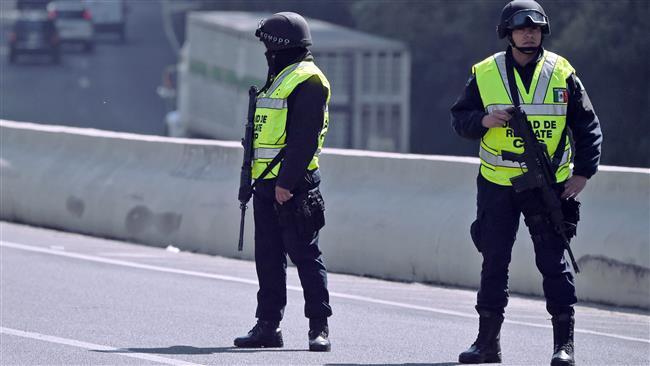
Federal police officers and soldiers are seen at a checkpoint in Mexico City on July 13, 2015. (Photo by AFP)

The United Nations has called on Mexico to end its controversial program, under which army personnel have undertaken the duties of police and law enforcement forces on the streets.

The UN High Commissioner for Human Rights Zeid Ra’ad al-Hussein on Wednesday called on Mexico to set a timetable to meet the world body’s demand and replace the military forces with police.

Mexican President Enrique Pena Nieto’s government must “adopt a time frame for the withdrawal of the military from public security functions,” as army forces have not been trained to do police tasks, the UN official says.

In late 2006, former president, Felipe Calderon, deployed troops on the streets to crack down on organized crime as part of a wider and ongoing war on drugs.

However, human rights organizations have recently said soldiers deployed to streets of Mexico were committing crimes and other abuses.

Hussein criticized Mexico’s police, judicial and investigative system for failing the nation, saying its poor performance has led to 26,000 disappearances and thousands of killings.

“No one in Mexico can feel safe,” said the UN official, adding, “They’re not enjoying the protection of the law.”

Fate of missing students

Elsewhere in his comments, Hussein urged the Mexican government to follow the recommendations of independent experts from the Inter-American Commission on Human Rights and start a new investigation into the high-profile case of 43 students that went missing last year.

A student walks past portraits of some of the 43 missing students of the rural teacher college of Ayotzinapa placed by fellow students in front of the Congress of the state of Guerrero in Chilpancingo, Mexico, on September 24, 2015. (Photo by AFP)

On September 26, 2014, the 43 students, all trainee teachers, disappeared in the city of Iguala in the southern state of Guerrero following an attack by police forces suspected of having links to drug gangs. The incident took place during a protest rally over teachers’ rights.

The parents of the students say corrupt local police abducted the missing students and handed them over to a drug gang, which purportedly killed them.

Earlier this year, a statement by the Mexican attorney general said that investigators were certain that the 43 college students missing were killed and incinerated.

The parents of the students say corrupt local police abducted the missing students and handed them over to a drug gang, which purportedly killed them.

Earlier this year, a statement by the Mexican attorney general said that investigators were certain that the 43 college students missing were killed and incinerated.

Reacting to Hussein’s comments, the Mexican Foreign Relations Department said the “government agrees with the high commissioner that all of us authorities on the state, federal and local levels should improve our efforts to protect human rights.”

Student massacre demonstration turns violent in Mexico

Student massacre demonstration turns violent in Mexico
http://www.presstv.com/Detail/2015/10/03/431758/Mexico-Protest-Mexico-City-Oaxaca-Police-
Sat Oct 3, 2015 8:58AM

A group of masked protesters clash with the federal police in Mexico City on 2 October, 2015 after a demonstration to commemorate the 47th anniversary of a 1968 massacre of students by the army. (© AFP)

Clashes have erupted between protesters and police in Mexico after thousands of people took to the streets of the capital to commemorate the 47th anniversary of a student massacre in the South American country.

According to Mexican officials, the Friday demonstration in the capital Mexico City turned violent when about 300 “anarchists” lobbed stones and firebombs at the police guarding the National Palace, which is home to the country’s President Enrique Pena Nieto.

Officials said police responded by firing tear gas, and that the violence lasted for around one hour.

The organizers of the rallies called for restraint from both sides.

Federal police officers clash with a group of masked protesters in Mexico City on 2 October, 2015 after a demonstration to commemorate the 47th anniversary of a 1968 massacre of students by the army. (© AFP)

In a similar protest in the southern city of Oaxaca, 52 masked youths were arrested for offenses, including vandalizing shops and banks, according to local authorities.

Both incidents of violence come after large national marches were held to mark the anniversary of a 1968 massacre of students by the army in a Mexico City neighborhood.

The students had been demanding an end to what they called repression by their government. Civil society groups say the real number of those killed by police at the time was in fact much higher than the official death toll of 40.

This year’s rallies drew more than 15,000 people in the capital alone.

Mexico extradites 13 drug traffickers to US

Mexico extradites 13 drug traffickers to US
http://www.presstv.com/Detail/2015/10/01/431488/Mexico-extradition-thirteen-drug-trafickers-US
Thu Oct 1, 2015 9:3AM

Edgar Valdez Villareal, aka “La Barbie,” of the Beltran Leyva drug cartel, is presented to the press at the Federal Police headquarters in Mexico City, August 31, 2010. (Photo by AFP)

Mexico has extradited 13 drug traffickers, including high-profile suspects to the United States, authorities have confirmed.

“We have carried out the extraditions of 13 individuals... on court extradition requests from several jurisdictions in the United States,” Tomas Zeron, an official from Mexico’s Justice Ministry told AFP on Thursday.

A Mexican-American citizen, Edgar Valdez Villarreal, with the alias “La Barbie,” who is a top member of the notorious Leyva drug cartel, was among those sent to the US for trial, Zeron added.

Jorge Costilla, with the alias “El Coss,” was another high-profile drug trafficker extradited to the US, according to Zeron.

Two Mexican police officers stand next to a patrol car with a picture of fugitive drug lord Joaquin, July 28, 2015. (Photo by AFP)

The thirteen were long sought by the US. According to authorities, Washington in return plans to hand over some suspects in US jails who are sought by the Mexican government.

Mexico had in recent years balked at requests from the US for the extradition of drug cartel kingpins, including Joaquin “El Chapo” Guzman, the notorious drug lord who managed to escape a top federal prison in Mexico earlier this year.

Washington wanted the Mexican government to extradite him after his arrest in February 2014, but Mexico refused, in a bid to try him at home.

Just two weeks prior to his escape in July, the US filed an extradition request for Guzman.

13 Mexican officials held for trial over El Chapo's prison break

13 Mexican officials held for trial over El Chapo's prison break
http://www.presstv.com/Detail/2015/09/25/430645/Mexico-El-Chapo-Altiplano-prison-break-drug-cartel-
Fri Sep 25, 2015 8:10AM

Mexican drug lord Joaquin “El Chapo” Guzman

Mexico is set to try 13 public officials in connection with the escape from prison of drug lord Joaquin “El Chapo” Guzman, Mexican judicial authorities say.

In a statement issued on Thursday, Mexican court officials said that among those held for trial are the former coordinator general of the country’s federal prisons, as well as the former director general, the commander and several control room monitors of the Altiplano prison, where Guzman broke out from in July.

Eleven individuals are reported to be held at the same maximum-security prison as the drug kingpin was held. Two others, reportedly women, are being held at a prison in the Pacific state of Nayarit.

Two Mexican police officers stand next to a patrol car with a picture of fugitive drug lord Joaquin, July 28, 2015. (Photo by AFP)

Guzman escaped the prison on July 11, using a 1.5 kilometer-long tunnel dug into his cell.

Footage from the security cameras inside his cell showed the Sinaloa Cartel kingpin walking in the tunnel in his shower area before disappearing.

This was El Chapo’s second successful prison break. He escaped from another maximum-security facility in 2001, while hiding in a laundry basket after bribing officials.

Million-dollar bounty

The Mexican government has announced a reward of up to 60 million pesos (USD 3.8 million) in reward for information that could lead to the kingpin’s whereabouts.

The US Drug Enforcement Administration (DEA) is also offering a USD five-million bounty for details leading to the capture of the cartel leader.

Founded in 1980s, the Sinaloa Cartel is an international criminal organization based in Mexico, which is a major smuggler of illegal drugs into the US.

The group, also known as the Blood Alliance, is often referred to as the most powerful cartel in the Western hemisphere. The cartel is said to control much of the flow of cocaine and marijuana to the US.